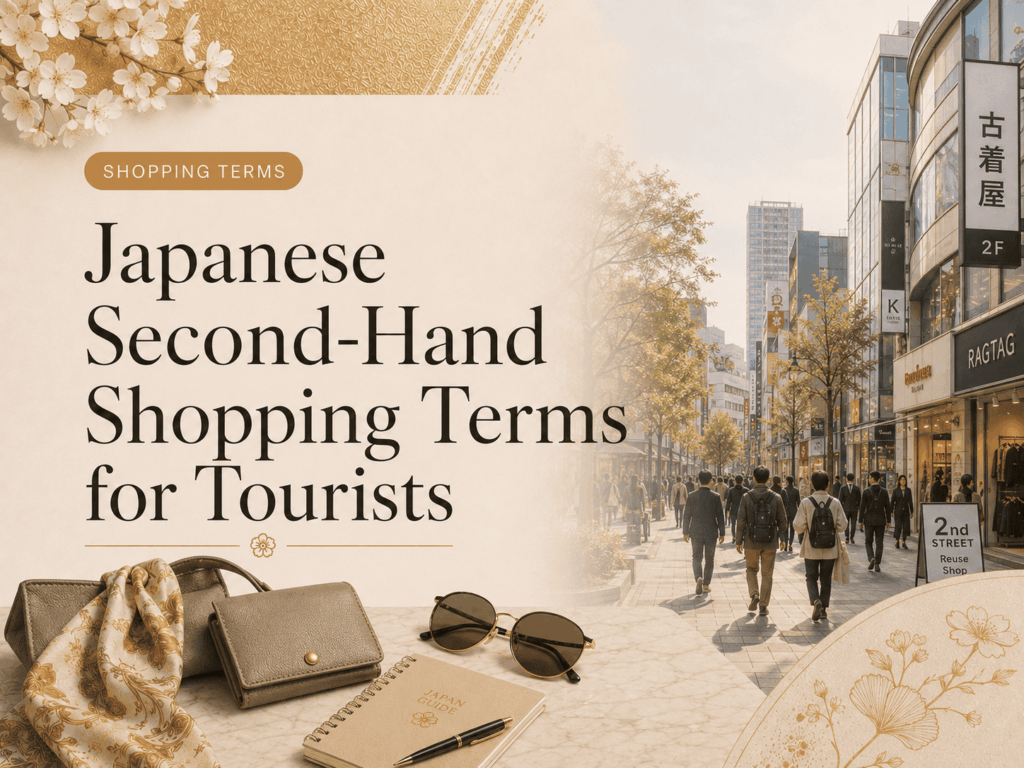
Japanese second-hand shopping becomes much easier when you can recognize a small set of words. You do not need to speak fluent Japanese. Knowing how shops describe used goods, stock, condition, accessories, fitting, payment, and tax-free procedures can help you read signs, search maps, and ask clearer questions.
This guide explains practical Japanese second-hand shopping terms for international visitors. Romanization is included as a reading aid, but pronunciation and shop usage can vary. A familiar word does not replace item-specific confirmation. Use these terms to begin a conversation, then ask staff to explain important condition or policy details before buying.
Instagram DM
Not sure which shops to visit?
Quick Answer for Tourists
Start with five words:
- `中古` (`chuko`): used or second-hand
- `古着` (`furugi`): used clothing
- `ヴィンテージ` (`vintage`): vintage
- `リユースショップ` (`ri-yusu shoppu`): reuse shop
- `在庫` (`zaiko`): stock or inventory
JVG Editorial View
Language preparation should reduce pressure, not turn a shopping day into a vocabulary test. JVG recommends saving a short note on your phone with the category you want, your size or model reference, and three questions that matter most. Showing a clear phrase beside an item tag is often more effective than attempting a long translated conversation.
The most useful words are not promotional terms. They are words that help you identify the shop type, understand the item, and pause before payment. A traveler who can ask about condition, included items, and return terms is better prepared than someone who memorizes many brand names but cannot clarify the purchase.
Core Words for Finding Second-Hand Stores
Chuko: Used or Second-Hand
`中古` is read `chuko` and commonly means used or second-hand. You may see it in combinations such as `中古品` (`chukohin`, used goods), `中古時計` (`chuko tokei`, used watches), or `中古カメラ` (`chuko kamera`, used cameras). In map searches, combining a city or station name with `中古` and the product category can produce more relevant results.
`中古` describes previously owned goods broadly. It does not tell you the age, condition, rarity, or value of an individual item. Read the shop's item description and inspect the product instead of treating the word as a quality grade.
Furugi: Used Clothing
`古着` is read `furugi` and means used clothing. A `古着屋` (`furugiya`) is a used-clothing shop. The store may carry inexpensive recent clothing, designer resale, streetwear, older garments, or a curated style. The term alone does not guarantee that everything is vintage in the historical sense.
Useful searches include a neighborhood name plus `古着`, such as `下北沢 古着` for used clothing in Shimokitazawa. Check the shop's own description to understand its style and price range.
Vintage
`ヴィンテージ` is the Japanese katakana spelling of "vintage." Shops may use it for older fashion, watches, bags, furniture, or other goods, but there is no single visitor-facing definition that applies to every store. Ask about the individual item's age or description when that distinction matters.
Avoid assuming `vintage` automatically means rare, valuable, or better made. The word helps identify a shopping style; the item still needs its own evaluation.
Reuse Shop
`リユースショップ` is read approximately `ri-yusu shoppu` and means reuse shop. In Japan, this often describes a business that buys and sells previously owned goods. Some branches cover fashion and accessories, while others may also handle household goods, electronics, hobby items, furniture, or sporting goods.
International travelers often search for "thrift stores," but a Japanese reuse shop may not operate like a charity shop. Understanding this difference helps set expectations before visiting.
Shichiya: Pawnshop
`質屋` is read `shichiya` and means pawnshop. Some pawn businesses also sell pre-owned goods, including luxury items, watches, jewelry, or other products. Selling activity, product categories, and visitor experience differ by business, so check what the shop actually offers before visiting.
Words You May See on Products
Jotai: Condition
Kizu: Scratch or Damage Mark
`傷` or `キズ` (`kizu`) refers to a scratch, mark, or damage. The exact meaning depends on the item and context. A bag description may refer to surface wear, while a watch or camera description may refer to a visible mark. Ask staff to show you the area if the written note is unclear.
Yogore: Dirt or Staining
`汚れ` (`yogore`) means dirt, staining, or soiling. For clothing and bags, inspect the area identified by the shop and decide whether it is acceptable for your use. Do not assume cleaning will remove it.
Shiyo-kan: Signs of Use
`使用感` (`shiyo-kan`) means signs or feeling of use. It can refer broadly to wear from previous ownership. Because the phrase is subjective, look at the item rather than relying only on the label.
Fuzokuhin: Included Accessories
`付属品` (`fuzokuhin`) means included accessories or accompanying items. Depending on the product, this might include a box, dust bag, strap, links, manual, card, case, charger, cap, or other parts. Ask `付属品は何ですか?` (`Fuzokuhin wa nan desu ka?`) to ask what is included.
Packaging and accessories should be confirmed for the exact item. Their presence does not by itself establish the item's history or quality.
Hon-tai: Main Item or Body
`本体` (`hontai`) means the main item, body, or unit. A listing that emphasizes `本体のみ` (`hontai nomi`) generally indicates the main item only. Ask what is and is not included before payment, especially for watches, cameras, electronics, and bags with removable parts.
Words for Stock and New Arrivals
Zaiko: Stock or Inventory
`在庫` (`zaiko`) means stock or inventory. `在庫ありますか?` (`Zaiko arimasu ka?`) asks whether stock is available. For a specific item, show a screenshot or product reference so staff know exactly what you mean.
Online information can change after an item is sold. A stock question is useful, but the answer should be understood as current at that moment rather than a future reservation unless the shop clearly confirms otherwise.
Nyuka: Arrival of Stock
Urikire: Sold Out
`売り切れ` (`urikire`) means sold out. You may also see `SOLD OUT` on English-friendly sites. If an item is gone, ask whether the shop has a similar category rather than assuming another identical item is available.
Toriyose: Store Transfer or Ordering
`取り寄せ` (`toriyose`) can refer to ordering or bringing an item from another location. Whether a shop offers this, how long it takes, and whether tourists can use the service depends on the business and item. Do not plan around a transfer unless the shop confirms the details.
Words for Trying, Sizing, and Comparing
Shichaku: Trying On
`試着` (`shichaku`) means trying on clothing. `試着できますか?` (`Shichaku dekimasu ka?`) asks whether you can try something on. Follow the shop's rules, particularly for delicate garments, jewelry, bags, or items displayed behind a counter.
Saizu: Size
`サイズ` (`saizu`) means size. Japanese clothing and ring sizes may differ from systems used elsewhere. Ask for measurements when possible. `寸法` (`sunpo`) means dimensions or measurements and may appear in detailed listings.
Hikaku: Comparison
`比較` (`hikaku`) means comparison. You do not need to use the word in conversation, but recognizing it can help when reading guides or product pages. For your own route, compare the same details at every shop: condition, size, accessories, total price, and purchase terms.
Payment and Visitor-Service Terms
Shiharai: Payment
`支払い` (`shiharai`) means payment. `支払い方法` (`shiharai hoho`) means payment method. Card acceptance and supported payment services can vary, so confirm the current options before a higher-value purchase.
Menzei or Tax-Free
Henpin: Return
`返品` (`henpin`) means return. `返品できますか?` (`Henpin dekimasu ka?`) asks whether a return is possible. Return terms can differ by store, item, payment method, and sale condition. Ask before payment and make sure you understand any restrictions.
Hosho: Warranty or Guarantee
`保証` (`hosho`) can mean warranty or guarantee. The scope, duration, issuer, and covered issues matter more than the word alone. For watches, cameras, jewelry, and other higher-value items, ask the shop to explain the exact written terms.
Hassou: Shipping
Short Questions Worth Saving
The following phrases are practical because they focus on the individual item:
- `付属品は何ですか?` (`Fuzokuhin wa nan desu ka?`) - What is included?
- `試着できますか?` (`Shichaku dekimasu ka?`) - May I try it on?
- `在庫ありますか?` (`Zaiko arimasu ka?`) - Is it in stock?
- `返品できますか?` (`Henpin dekimasu ka?`) - Is a return possible?
- `英語の説明はありますか?` (`Eigo no setsumei wa arimasu ka?`) - Is there an English explanation?
Politeness helps, but clarity matters more than perfect grammar. Show the item, point to the relevant note, and confirm numbers or terms in writing when possible.
Suggested Shopping Route
Before Leaving Your Hotel
Save the Japanese and English shop names, map pins, priority product category, and three key questions. Keep screenshots of any item references. Check official opening information and avoid building the route around one unconfirmed product.
At the First Shop
Use the first stop to learn the local language in context. Notice how the shop labels condition, accessories, sizes, and categories. Ask one simple question rather than attempting a long explanation. Record the answer in a way you can compare later.
At the Second Shop
Ask the same questions and note whether the terminology or grading system differs. Do not transfer one shop's condition grade directly to another. Compare the physical items and written information.
Before Payment
Confirm the item, included accessories, total price, payment method, tax-free procedure if relevant, and return or service terms. A translation app can support the conversation, but ask staff to confirm any detail that affects the purchase.
Best For Breakdown
Best for First-Time Visitors
- Learn `chuko`, `furugi`, `reuse shop`, `zaiko`, and `jotai` first.
- Save short questions rather than memorizing long sentences.
- Choose stores with clear category information and official map details.
Best for Luxury Shoppers
- Add `fuzokuhin`, `kizu`, `hosho`, and `henpin`.
- Confirm item-specific details before payment.
- Keep boxes, documents, receipts, and supplied accessories organized after purchase.
Best for Clothing Shoppers
- Add `furugi`, `shichaku`, `saizu`, and `sunpo`.
- Compare measurements instead of relying only on size labels.
- Ask permission before trying on delicate or displayed items.
Best for Watch and Camera Shoppers
- Add `hontai`, `fuzokuhin`, `jotai`, and `hosho`.
- Ask exactly which parts, documents, or service information are included.
- Confirm compatibility, operation, and shop terms without relying on automatic translation alone.
JVG Shop Selection Notes
These examples represent different second-hand store formats where travelers may encounter the vocabulary in this guide. They are not ranked, and current inventory or language support is not guaranteed.
BRAND OFF Nagoya Osu Store
- Area: Osu
- Best for: Luxury resale terminology
- Why it fits this guide: A focused resale shop is a useful setting for recognizing words related to brand goods, accessories, and item condition.
- Before visiting: Check the official website and map before visiting. Current inventory, hours, services, and policies are not confirmed here.
KOMEHYO Nagoya Main Store Main Building
- Area: Nagoya
- Best for: Multi-category terminology
- Why it fits this guide: A multi-category store can expose travelers to vocabulary used for jewelry, watches, bags, fashion, and cameras.
- Before visiting: Check the official website and map before visiting. Current inventory, hours, services, and policies are not confirmed here.
Gallery Rare Namba
- Area: Namba
- Best for: Pre-owned luxury shopping language
- Why it fits this guide: A luxury-focused stop is relevant to questions about included items, condition, and item-specific details.
- Before visiting: Check the official website and map before visiting. Current inventory, hours, services, and policies are not confirmed here.
BRAND OFF Shinsaibashi Store
- Area: Shinsaibashi
- Best for: Bags, watches, and jewelry terms
- Why it fits this guide: Its broad luxury categories make it a practical example of where category-specific language may appear.
- Before visiting: Check the official website and map before visiting. Current inventory, hours, services, and policies are not confirmed here.
RAGTAG Fukuoka PARCO
- Area: Tenjin
- Best for: Used designer fashion language
- Why it fits this guide: A fashion-led store is relevant to terms for clothing, sizing, condition, and trying items on.
- Before visiting: Check the official website and map before visiting. Current inventory, hours, services, and policies are not confirmed here.
Quark Fukuoka
- Area: Tenjin
- Best for: Pre-owned watch terminology
- Why it fits this guide: A specialist watch shop illustrates why product-specific words and clear questions matter for higher-value purchases.
- Before visiting: Check the official website and map before visiting. Current inventory, hours, services, and policies are not confirmed here.
How to Compare These Shops
Use the same language checklist across different formats. Identify the category, ask about condition, confirm included items, and clarify the payment or policy detail that matters most. A fashion store and a watch specialist may use different product language, but the underlying comparison process remains useful.
Do not judge English support by the brand name or neighborhood. Some staff may communicate comfortably in English, while others may use translation tools or written information. Prepare to meet the shop halfway with short questions and saved references.
What to Check Before Visiting
- Check the official website and map before visiting.
- Save the shop name in Japanese and English when available.
- Confirm that the branch handles your category.
- Remember that inventory and prices change frequently.
- Prepare item photos, model references, measurements, or sizes.
- Ask directly about tax-free procedures, returns, warranties, and shipping.
- Confirm important numbers and item details before payment.
Related JVG Guides
- complete guide to second-hand stores in Japan
- how reuse shops work in Japan
- thrift stores in Japan for international visitors
- second-hand shopping tips for international visitors
- how to shop second-hand in Japan without speaking Japanese
- how to buy second-hand luxury goods in Japan
- vintage shopping in Japan
Planning Support
If you are planning a focused second-hand shopping day in Japan, JVG can help you organize areas, shop types, and realistic routes. A clear route can reduce language pressure by giving each stop a specific purpose.
Need help planning your vintage shopping route in Japan? Contact JVG for private shopping support.
Shopping Support: /shopping-support/
FAQ
What is the Japanese word for second-hand?
`中古` (`chuko`) is a common word for used or second-hand. `中古品` means used goods, while more specific combinations can describe used watches, cameras, and other categories.
What does furugi mean?
`古着` (`furugi`) means used clothing. A `古着屋` (`furugiya`) is a used-clothing shop. The term does not guarantee that every item is old enough to be considered vintage.
What is a reuse shop in Japan?
A `リユースショップ` is a business that buys and sells previously owned goods. Product categories vary by chain and branch, and the format may differ from the charity-shop meaning of "thrift store."
How do I ask whether an item is in stock?
You can ask `在庫ありますか?` (`Zaiko arimasu ka?`). Show the item photo, listing, or model reference so the staff can identify what you mean.
Do I need to speak Japanese to shop second-hand in Japan?
No, but a few saved terms and short questions can make the experience easier. Use translation tools for support and confirm important item, payment, and policy details directly with the shop.
Continue the shopping journey