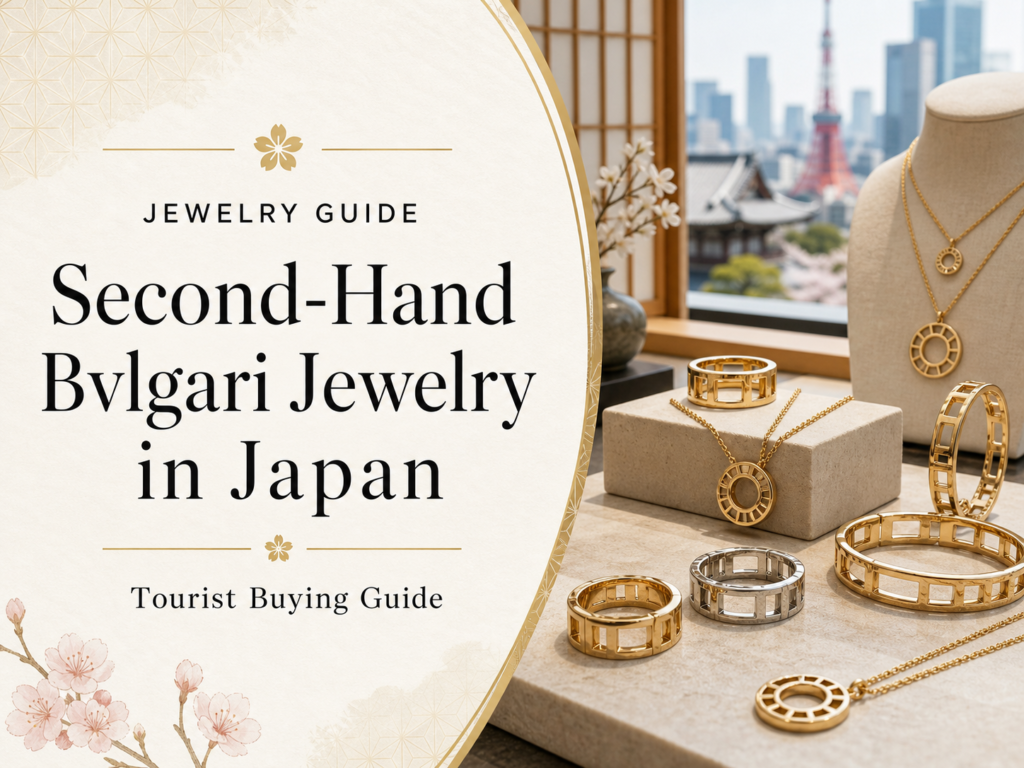
Buying second-hand Bvlgari jewelry in Japan can be a practical way to compare several pieces during one trip, but the useful short answer is not "go to one famous shop." Decide the exact format, size, material, and condition you want; compare at least two individual pieces; and confirm every purchase term with the seller before paying. Used jewelry is item-specific, so a relevant shop cannot promise today's brand selection, price, condition, documents, or visitor services.
Japan's major resale districts can make comparison efficient. Ginza is useful for a compact luxury-led route, Omotesando and Shibuya can add fashion context, and Shinsaibashi provides a strong central-Osaka base. Check official pages, maps, opening information, and branch details shortly before visiting.
Instagram DM
Not sure which shops to visit?
Quick Answer for Tourists
Start with the piece you want to wear, not just the collection name. Save measurements, your ring or bracelet size, preferred metal or material, and one acceptable alternative. At the first store, establish a reference for scale, fit, surface condition, clasp or mechanism, included items, and displayed price. At the second, repeat the same checks.
Bring your passport if you intend to ask about tax-free shopping, but confirm eligibility and procedure directly. Returns, exchanges, resizing, cleaning, repair, warranty, shipping, payment, and language support can differ by seller and item. Clarify these points before purchase, especially when you will soon leave Japan.
JVG Editorial View
JVG treats branded jewelry shopping as an item comparison, not a shortcut from logo to certainty. The strongest candidate is the piece you can identify, inspect, wear comfortably, and maintain with confidence. A recognizable design, elegant display, box, or document may add context, but none removes the need to inspect the jewelry itself.
Travel can create artificial urgency. You may see only one example in your size or feel that the day is running out. Step away when possible, review your notes, and decide whether the remaining uncertainty fits your budget and purpose. A memorable trip does not require a purchase.
Condition should be judged in relation to design and intended use. Fine scratches on a broad polished surface, wear on a clasp, soft engraving, chain distortion, or evidence of resizing may matter differently. Decide your acceptable wear before entering the store so presentation does not move your standard.
Decide What Kind of Bvlgari Jewelry You Need
Choose the piece type and collection range
Relevant options may include B.zero1 rings and pendants, Serpenti forms, Divas' Dream motifs, Bvlgari Bvlgari designs, chains, bracelets, and pieces combining metal with ceramic, stone, or other materials. The collection name alone is not enough. A ring, rigid bracelet, chain bracelet, pendant, necklace, or pair of earrings presents different questions about sizing, movement, contact points, and future care.
Select one preferred piece type and one alternative. For example, compare a pendant with another pendant before switching to a bracelet simply because it is available. A stable search brief makes differences easier to evaluate.
Record identity and measurements
For each candidate note collection and variant when documented, size, measurements, metal and material description, link or mechanism type, hallmarks, reference information when available, included accessories, and condition notes. Ask staff to explain the written description and measurement method. Similar-looking variants may differ in scale, thickness, chain length, motif count, metal, inserts, or construction.
Do not rely on a product nickname or a distant photograph. Inspect markings only with staff permission and avoid drawing a conclusion from one stamp or accessory. Identity should be understood from the piece, seller description, documented details, and your own risk tolerance together.
Define your fit standard
Wide rings and sculptural bracelets can feel different from slim pieces with the same nominal size. Try the item when permitted and check movement through a normal range without forcing any articulated section or clasp.
Fit is part of condition because an item that twists, pinches, catches, or cannot be secured easily may not suit daily use. Ask before trying on and follow staff instructions. Do not force a ring, hinge, clasp, chain, or articulated section.
Decide how much surface wear you accept
Used jewelry will often show handling and wear. Some buyers accept fine marks but care about shape and mechanism. Others want crisp engraving and minimal refinishing. Write down your priorities before comparison, including how you feel about resizing, polishing, replaced parts, missing accessories, or undocumented repair.
For Bvlgari, inspect ring edges, spiral or articulated construction, hinges, spring-like movement where relevant, chain links, clasps, ceramic or stone inserts, polished surfaces, engraving, symmetry, setting security, and repair evidence. Ask what is described, what service or repair evidence exists, and what remains unknown.
Where to Look in Japan
Ginza
Ginza works well for a concentrated luxury-resale comparison. Several shop formats can be combined without turning the day into a long cross-city route. It is also useful when a travel companion wants to compare watches or bags.
Save exact entrances and floors, then choose two priority stores with different roles. Use one to establish a broad reference and the other to compare presentation, condition language, and item details. Add a third only if it resolves a question.
Omotesando and Shibuya
Omotesando and Shibuya suit travelers combining jewelry with fashion or vintage shopping. The areas are close on a transit map, but crowds, slopes, and side streets consume time. Choose one primary cluster and one optional extension rather than attempting every shop.
Shinjuku
Shinjuku is practical for transport convenience and broad luxury comparison. Group stores by station side and check the correct exit. A short route near your hotel may be more productive than traveling to a famous district for one uncertain piece.
Shinsaibashi and central Osaka
Shinsaibashi is a natural base for a Kansai luxury-resale day. Compare two nearby sellers first. Add Namba or Umeda only when the move serves a clear purpose, such as seeing another store format or combining the trip with sightseeing.
How to Inspect Second-Hand Bvlgari Jewelry
Confirm what the item is
Ask for the seller's description, material information, dimensions, size, included accessories, and any documented reference details. Understand which statements are about the piece and which are general collection information. If an essential point is unclear, do not fill it in from memory.
Inspect under more than one angle
Look from front, back, sides, edges, and contact surfaces. Neutral light can reveal marks that display lighting hides. Compare symmetry, profile, thickness, engraving, and transitions between finishes. Ask before using a loupe or moving removable parts.
Check mechanisms and high-stress points
Clasps, hinges, screws, jump rings, solder joints, chain links, earring posts and backs, pendant bails, and articulated elements receive repeated stress. Ask staff to demonstrate when you are unsure. Do not repeatedly test or force a mechanism.
Evaluate stones, shell, ceramic, and other inserts
Different materials respond differently to impact, moisture, cosmetics, heat, and cleaning. Look for chips, scratches, gaps, movement, uneven surfaces, and setting concerns. Ask what material is described and what care guidance the shop can provide. Do not assume a cleaning method is safe for every piece.
Consider polishing, resizing, and repair
Refinishing can change edge definition, engraving, proportions, and surface transitions. Resizing may affect marks or symmetry. Repair can be reasonable, but it should fit your expectations. Ask whether the seller has any documentation; absence of evidence should remain an unknown.
Review included items without overvaluing them
Boxes, pouches, certificates, receipts, booklets, and service papers vary. Confirm exactly what is included and whether identifying information corresponds to the piece. Accessories can support context, but the jewelry's identity, condition, and fit remain central.
Suggested Shopping Route
Half-day Tokyo route
Choose Ginza for a luxury-focused route or Omotesando and Shibuya for a fashion-linked route. Start at a broad reseller, then visit one contrasting format. Take a break and compare notes before using the backup stop.
Record item type, size, measurements, materials, visible wear, mechanism, included items, displayed total, and questions. When photographs are not permitted, write the item details outside the shop.
Full-day Tokyo route
Use one area in the morning and one in the afternoon. Ginza followed by Omotesando can offer useful contrast, but allow transit, meals, and inspection time. Do not schedule the final decision immediately before a reservation or airport transfer.
Osaka route
Begin in Shinsaibashi and compare two nearby luxury-resale sellers. Add one optional Namba or Umeda stop only if it broadens the comparison. Keep jewelry stored securely and avoid carrying unnecessary luggage during the route.
Best For Breakdown
First-time branded-jewelry buyers
- Compare the same piece type at two stores.
- Prioritize understandable item details, fit, and purchase terms.
- Ask staff to demonstrate mechanisms rather than experimenting.
Travelers buying a daily piece
- Focus on comfort, closure security, wear tolerance, and care.
- Consider how the piece interacts with clothing, luggage, and normal activity.
- Plan insurance, customs, storage, and maintenance after the trip.
Collectors seeking a specific variant
- Save exact dimensions, materials, references, and acceptable alternatives.
- Contact sellers before making a distant trip.
- Keep uncertain period or repair claims separate from documented facts.
Visitors with limited time
- Choose one district, two priority stops, and one backup.
- Avoid changing piece type simply because the target is unavailable.
- Leave a quiet comparison window before purchase.
JVG Shop Selection Notes
These shops are practical route references, not a ranking. Inclusion does not confirm present Bvlgari inventory, price, condition, tax treatment, or service. Check the exact branch through official channels before visiting.
ALLU Ginza
- Area: Ginza
- Best for: A multi-category luxury-resale reference point
- Why it fits: This stop gives travelers a practical place to compare second-hand Bvlgari jewelry within a focused route. Inclusion is about route usefulness, not a statement about today's stock.
- Before visiting: Check the official website and map, confirm the exact branch and relevant department, and ask directly about any item-specific service or purchase term.
BRAND OFF Ginza Main Store
- Area: Ginza
- Best for: A multi-category luxury comparison
- Why it fits: This stop gives travelers a practical place to compare second-hand Bvlgari jewelry within a focused route. Inclusion is about route usefulness, not a statement about today's stock.
- Before visiting: Check the official website and map, confirm the exact branch and relevant department, and ask directly about any item-specific service or purchase term.
KOMEHYO Ginza
- Area: Ginza
- Best for: A broad luxury-resale comparison
- Why it fits: This stop gives travelers a practical place to compare second-hand Bvlgari jewelry within a focused route. Inclusion is about route usefulness, not a statement about today's stock.
- Before visiting: Check the official website and map, confirm the exact branch and relevant department, and ask directly about any item-specific service or purchase term.
Gallery Rare Ginza Main Store
- Area: Ginza
- Best for: A luxury-resale stop in a compact district
- Why it fits: This stop gives travelers a practical place to compare second-hand Bvlgari jewelry within a focused route. Inclusion is about route usefulness, not a statement about today's stock.
- Before visiting: Check the official website and map, confirm the exact branch and relevant department, and ask directly about any item-specific service or purchase term.
ALLU Omotesando
- Area: Omotesando
- Best for: A luxury stop that can be paired with Aoyama
- Why it fits: This stop gives travelers a practical place to compare second-hand Bvlgari jewelry within a focused route. Inclusion is about route usefulness, not a statement about today's stock.
- Before visiting: Check the official website and map, confirm the exact branch and relevant department, and ask directly about any item-specific service or purchase term.
BRAND OFF Shibuya Store
- Area: Shibuya
- Best for: A luxury-resale option in a fashion district
- Why it fits: This stop gives travelers a practical place to compare second-hand Bvlgari jewelry within a focused route. Inclusion is about route usefulness, not a statement about today's stock.
- Before visiting: Check the official website and map, confirm the exact branch and relevant department, and ask directly about any item-specific service or purchase term.
ALLU Shinsaibashi
- Area: Shinsaibashi
- Best for: A central Osaka luxury-resale route
- Why it fits: This stop gives travelers a practical place to compare second-hand Bvlgari jewelry within a focused route. Inclusion is about route usefulness, not a statement about today's stock.
- Before visiting: Check the official website and map, confirm the exact branch and relevant department, and ask directly about any item-specific service or purchase term.
Gallery Rare Shinsaibashi Main Store
- Area: Shinsaibashi
- Best for: A luxury comparison in central Osaka
- Why it fits: This stop gives travelers a practical place to compare second-hand Bvlgari jewelry within a focused route. Inclusion is about route usefulness, not a statement about today's stock.
- Before visiting: Check the official website and map, confirm the exact branch and relevant department, and ask directly about any item-specific service or purchase term.
How to Compare These Shops
Use the first shop to create a benchmark and the second to test it. Repeat the same order: identity, dimensions, fit, condition, mechanism, included items, displayed total, and policy questions. A third stop should answer a defined uncertainty rather than extend the route without purpose.
Compare seller explanations carefully. Condition ranks and terminology may differ, so read the item notes and inspect the actual piece. Ask about returns, exchange, resizing, cleaning, repair, warranty, shipping, payment, and tax-free procedure before payment because no single policy should be assumed.
Shopping Without Speaking Japanese
Save the brand, collection or piece type, size, dimensions, preferred material, and budget. Useful questions include "May I try this on?", "What size is this?", "What is included?", "Has this been resized or repaired?", "Could you show me the condition notes?", and "What are the current purchase terms?"
Translation tools can help with basic communication. For important details, ask staff to point to written information where possible. English support can vary, so allow extra time and keep receipts and descriptions organized.
What to Check Before Visiting
- Check the official website, map, exact branch, department, and opening information.
- Do not assume a shop currently carries the brand, collection, size, or material you want.
- Bring measurements, size references, and one acceptable alternative.
- Ask directly about trying on, returns, exchange, resizing, cleaning, repair, warranty, shipping, payment, and aftercare.
- Bring your passport if you plan to ask about tax-free shopping, then confirm current eligibility and procedure.
- Plan secure storage, insurance, and customs declarations for the remainder of the trip.
- Avoid a final decision under a train, reservation, or flight deadline.
Related JVG Guides
- Read the second-hand jewelry in Japan guide.
- Read the second-hand jewelry in Tokyo guide.
- Read the second-hand jewelry in Ginza guide.
- Read the second-hand jewelry in Osaka guide.
- Read the how to buy second-hand luxury goods in Japan.
- Read the how to compare condition on used luxury goods.
- Read the tax-free shopping for second-hand goods.
FAQ
Is Japan practical for comparing second-hand Bvlgari jewelry?
It can be practical because major visitor districts contain multiple luxury-resale shops. The advantage is comparison, not a promise of stock or price. A focused route and stable checklist are more useful than visiting many unrelated branches.
Do a box and documents establish everything about a piece?
No. Confirm what each accessory states and whether identifying details correspond to the jewelry, but also inspect the piece, fit, mechanism, condition, and seller description. Seek independent specialist advice when an unresolved risk is material to your decision.
Can a shop resize, clean, or repair the jewelry for me?
Services and eligibility can vary by seller, item, design, timing, and destination. Ask before buying and do not assume work can be completed during a short trip. Consider whether a qualified provider at home can support the piece.
Are tax-free shopping and returns consistent across shops?
No. Tax procedures, eligibility, returns, exchange, warranty, and aftercare can differ. Confirm the exact terms before payment and keep the written receipt and item description.
How many jewelry shops should I visit in a day?
Two to four focused stops are enough for many travelers. The limiting factor is not distance alone; it is your ability to compare fit and condition consistently. Stop when fatigue begins to weaken your checklist.
Shopping Support CTA
Need help planning your vintage shopping route in Japan? Contact JVG for private shopping support.
Shopping Support: Plan your route with JVG
Continue the shopping journey