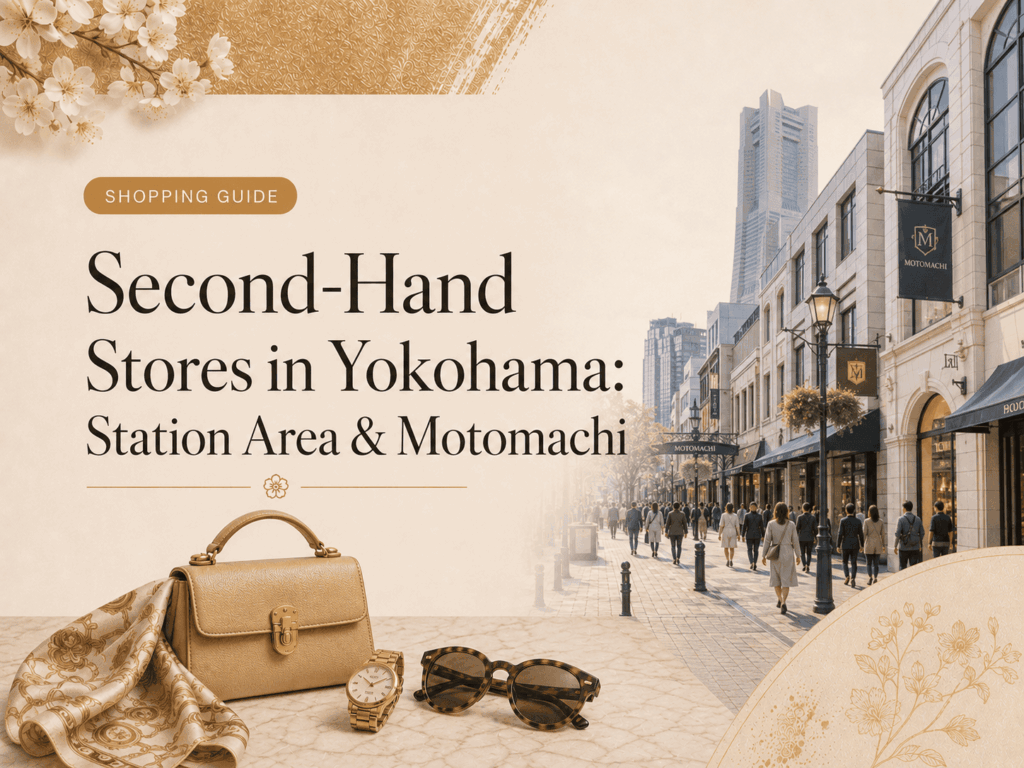
Yokohama works well for second-hand shopping when it is treated as several separate route choices rather than one enormous citywide loop. The station area is convenient for transport and multi-category browsing, while Motomachi offers a different atmosphere that can fit waterfront sightseeing. Suburban reuse stores belong to separate plans.
This guide answers a practical question: which part of Yokohama should an international visitor choose for second-hand shopping? It covers general reuse stores, designer fashion resale, pre-owned luxury shops, and specialist categories such as watches. It does not promise current inventory, prices, opening hours, tax-free availability, return terms, warranties, or language support. Check official store information before visiting.
Instagram DM
Not sure which shops to visit?
Quick Answer for Tourists
Choose one primary district and one optional backup. A general second-hand search is usually easier when you compare store formats instead of expecting every shop to carry the same products. Reuse chains may cover several everyday categories, fashion resale shops may focus on clothing and accessories, luxury resale shops may be more relevant to bags or jewelry, and watch specialists serve a narrower purpose.
If you have only a few hours, stay in the district that best matches your hotel, transport, and main category. If you have a full day, add a second district only after the first group of shops has shown you what is missing. This approach protects sightseeing time and gives you enough space to inspect any purchase carefully.
JVG Editorial View
JVG recommends Yokohama to travelers who want a second-hand shopping day outside central Tokyo without giving up route flexibility. The station area is the safest first choice for limited time. Motomachi becomes more attractive when it already fits a Chinatown or waterfront itinerary. Mixing distant suburban branches into the same day usually weakens the route.
The goal is not to identify one permanent winner. Inventory changes, branches serve different audiences, and the most useful shop depends on what you want that day. JVG recommends using the first stop to establish a reference point, the second to compare a different format, and the third only when it answers a clear question.
This article also has a distinct role within JVG. This article compares Yokohama's main districts and store formats. The station article remains the detailed station route, while the existing Yokohama vintage article remains the curated shop overview. Use the related guides near the end when you need a more specific route or product category.
What Counts as a Second-Hand Store in Japan?
Reuse Shops
Reuse shops buy and sell previously owned goods. Depending on the chain and branch, shoppers may encounter clothing, bags, shoes, accessories, watches, household items, electronics, hobby goods, or other categories. The English search term "thrift store" may lead visitors to these shops, but the business model and product mix may differ from a charity shop in another country.
Vintage and Used Fashion Stores
Fashion-focused stores may emphasize designer labels, streetwear, older clothing, contemporary resale, or a particular style. "Vintage" and "used" are not always interchangeable. A store may carry recent second-hand fashion alongside older pieces, so judge the individual item and the shop's own description.
Pre-Owned Luxury Shops
Luxury resale shops may handle bags, wallets, watches, jewelry, and accessories. Some stores cover several categories; others feel more specialized. Current brand and model availability changes frequently. A familiar shop name does not confirm that the branch has the item you want today.
Specialist Stores
Watch, camera, jewelry, and other specialist stores can be useful when your questions are technical or category-specific. They may require more time than general browsing because condition, accessories, specifications, service history, sizing, or compatibility can affect the decision. Confirm what information the seller provides for the individual item.
Best Areas for Second-Hand Shopping
Yokohama Station: The Efficient First Choice
The station area offers the simplest transport base and a useful mix of luxury resale, designer fashion, and general second-hand shopping. Large station buildings, east and west exits, and connected commercial spaces can make short distances feel slower than expected. Confirm which side of the station each shop is on before setting the order.
Motomachi: Shopping With a Waterfront Itinerary
Motomachi is better treated as a distinct shopping session. It can fit naturally with Chinatown, Yamashita Park, and the wider waterfront, but it should not be described as an extension of the station-area walk. Choose it when the neighborhood itself is part of your travel day.
Wider Yokohama: Separate Reuse-Shop Trips
Yokohama has reuse and fashion-resale stores across a broad urban area. Some may be useful for travelers staying locally or using a nearby rail line, but they are not automatic tourist stops. Check transport, branch categories, and official details before giving up central sightseeing time.
These district roles are planning tools, not fixed rankings. Store locations, building access, and transport conditions can change. Save the official address for each priority stop and check the map on the day of your visit.
What You Can Shop For
Used Clothing and Designer Fashion
Clothing shoppers should compare measurements, fabric condition, alterations, stains, odor, and signs of wear. Japanese size labels may not match the sizing system you use at home. Try items on when permitted or compare the listed measurements with clothing you already own.
Pre-Owned Bags and Accessories
Bag shoppers can compare structure, corners, handles, straps, lining, hardware, closures, and included accessories. A lower price does not automatically make one bag the better choice, and a higher price does not guarantee a condition level. Consider how the item will work during travel and after you return home.
Watches and Jewelry
Higher-value categories deserve a slower pace. Ask what is included, what condition information is stated, and which shop terms apply. For watches, consider fit, operation, accessories, and any service information provided. For jewelry, consider size, materials, visible wear, repairs, and included documents without making assumptions the shop has not confirmed.
General Reuse Items
Broader reuse stores can be useful for travelers who enjoy open-ended browsing or want to understand how Japan's resale market differs from luxury-focused shopping. Category depth varies by branch. Confirm transportation and product categories before visiting an outlying store for one specific item.
Suggested Shopping Route
Half-Day Route
Stay around Yokohama Station and choose two or three contrasting shops: one multi-category resale store, one fashion-led option, and one specialist only if it matches your goal. Use the existing station route for detailed navigation and leave Motomachi for another part of the trip.
Allow time for a cafe or lunch break after the first two stops. Use that pause to compare notes, item details, locations, and the remaining route. If the first shops do not match your goal, adjust the category or choose the nearby backup instead of crossing the city immediately.
One-Day Route
Begin around Yokohama Station, compare a focused shortlist, and then move to Motomachi only if waterfront sightseeing is also planned. Treat the transfer as a change of neighborhood, not a continuous shopping street. Add a cafe or lunch break before evaluating any higher-value purchase.
Divide the day into a morning question and an afternoon question. For example, the morning can establish which shop type and condition level you prefer. The afternoon can compare a different district or specialist category. A route is more useful when each move has a reason.
Route Rules That Save Time
- Save the first shop and one nearby backup before leaving your hotel.
- Check station exits and building names, especially around major terminals.
- Keep distant suburban branches as separate trip options.
- Avoid carrying large luggage through a comparison route when possible.
- Leave enough time to return to a preferred item without rushing.
- Check the map before visiting rather than relying only on district names.
Best For Breakdown
Best for Travelers staying near Yokohama Station
- The central cluster is easy to combine with rail travel.
- Keep the active route focused on the district that serves this purpose.
- Confirm current shop details before making a special journey.
Best for Luxury resale comparison
- Several station-area stores support bags, watches, jewelry, and accessories.
- Keep the active route focused on the district that serves this purpose.
- Confirm current shop details before making a special journey.
Best for Designer fashion
- Fashion-led resale can be paired with broader station-area shopping.
- Keep the active route focused on the district that serves this purpose.
- Confirm current shop details before making a special journey.
Best for Sightseeing and shopping
- Motomachi can fit a Chinatown and waterfront day when planned separately.
- Keep the active route focused on the district that serves this purpose.
- Confirm current shop details before making a special journey.
JVG Shop Selection Notes
The following shops show different ways to approach second-hand shopping in Yokohama. They are not ranked, and inclusion does not confirm live inventory or visitor services. Choose the stops that match your district and category rather than treating the list as a checklist.
Daikokuya Yokohama
- Area: Yokohama
- Best for: Luxury and brand resale
- Why it fits this guide: It is relevant to a station-area route for visitors comparing higher-value categories.
- Before visiting: Check the official website and map before visiting. Current inventory, hours, services, and policies are not confirmed here.
KOMEHYO Yokohama
- Area: Yokohama
- Best for: Multi-category luxury resale
- Why it fits this guide: It supports comparison across bags, watches, jewelry, and fashion around central Yokohama.
- Before visiting: Check the official website and map before visiting. Current inventory, hours, services, and policies are not confirmed here.
Rodeo Drive Motomachi
- Area: Yokohama
- Best for: Motomachi luxury resale
- Why it fits this guide: It gives the Motomachi section a clear category-focused stop within a separate neighborhood plan.
- Before visiting: Check the official website and map before visiting. Current inventory, hours, services, and policies are not confirmed here.
RAGTAG NEWoMan Yokohama
- Area: Yokohama
- Best for: Designer and vintage fashion
- Why it fits this guide: It adds a fashion-led option that fits naturally with the station-area itinerary.
- Before visiting: Check the official website and map before visiting. Current inventory, hours, services, and policies are not confirmed here.
2nd STREET Yokohama
- Area: Yokohama
- Best for: General reuse shopping
- Why it fits this guide: It provides a broader reuse-shop comparison against more focused luxury and fashion stores.
- Before visiting: Check the official website and map before visiting. Current inventory, hours, services, and policies are not confirmed here.
BOOKOFF PLUS Yokohama
- Area: Yokohama
- Best for: Broad second-hand browsing
- Why it fits this guide: It is useful for travelers who want to understand a wider Japanese reuse format.
- Before visiting: Check the official website and map before visiting. Current inventory, hours, services, and policies are not confirmed here.
How to Compare These Shops
Compare Store Format
Ask what each stop contributes. A broad reuse shop can establish the general market, a designer fashion store can answer clothing questions, a luxury resale shop can support bags or jewelry, and a specialist can provide category focus. Visiting several stores of the same type is useful only when you are making a direct comparison.
Compare the Individual Item
Condition language may differ between businesses. Inspect the physical item within the shop's rules and ask staff to explain anything unclear. Compare visible wear, size or fit, included accessories, item details, and total price. Do not assume that two similar products have the same history or condition.
Compare Route Cost
Time and energy are part of the shopping decision. A distant shop may be worthwhile for a specialist category, but less useful for general browsing. Consider transfers, station size, weather, crowds, and the effect of carrying purchases. The most efficient route often produces better decisions than the longest route.
Compare Purchase Terms
Payment, tax-free procedures, returns, repairs, warranties, shipping, and other services can vary by shop and item. Ask before payment and make sure you understand the answer. Bring your passport if you plan to ask about tax-free shopping, but do not assume every shop or purchase qualifies.
Shopping Without Speaking Japanese
Prepare short, specific questions and show the item tag or product reference when appropriate. Useful English questions include:
- "Can I check the condition?"
- "What is included with this item?"
- "May I try this on?"
- "Could you explain this note?"
- "Does this shop offer tax-free shopping for this purchase?"
- "What are the return terms for this item?"
A translation app can help with simple communication, but important numbers, measurements, materials, and policies should be confirmed directly. Save shop names in Japanese when available because map listings and building directories may not use the same English spelling.
Price, Condition, and Inventory
Second-hand inventory changes as items are sold and new items arrive. An article or official category page can show that a shop is relevant, but it cannot promise what will be on the shelf during your visit. If one exact brand, model, size, color, or material is essential, check current official information or contact the shop before changing your itinerary.
Compare price together with condition, usefulness, and included accessories. Exchange rates and card-provider fees can change the amount paid in your home currency. Set a comfortable limit before the route and leave room for travel expenses, customs obligations, or later purchases.
What to Check Before Visiting
- Check the official website before visiting.
- Confirm the current address and map location.
- Make sure the branch handles your product category.
- Remember that inventory and prices change frequently.
- Prepare a passport if you plan to ask about tax-free shopping.
- Confirm payment, return, service, and shipping terms directly.
- Compare condition, size, accessories, and total price before buying.
- Keep one nearby backup instead of relying on one unconfirmed item.
Related JVG Guides
- complete guide to second-hand stores in Japan
- how reuse shops work in Japan
- thrift stores in Japan for international visitors
- second-hand shopping tips for international visitors
- vintage and second-hand shops in Yokohama
- second-hand shops near Yokohama Station
- used luxury bags in Yokohama
- pre-owned watches in Yokohama
Planning Support
If you are planning a focused second-hand shopping day in Japan, JVG can help you organize areas, shop types, and realistic routes. Planning is especially useful when several members of a group want different categories or when higher-value purchases need comparison time.
Need help planning your vintage shopping route in Japan? Contact JVG for private shopping support.
Shopping Support: /shopping-support/
FAQ
Is Yokohama good for second-hand shopping?
Yes, it can support several second-hand store formats when you choose the district that matches your category and schedule. Use a focused shortlist and verify shop details before visiting.
Are second-hand stores in Yokohama the same as thrift stores?
Not always. International visitors may use "thrift store" broadly, while Japanese reuse shops, vintage stores, fashion resale shops, and luxury resale businesses can have different models and product mixes.
Can I find a specific brand or model?
Possibly, but current inventory cannot be guaranteed. Check official information or contact the shop when a particular model, size, color, material, or condition is essential.
Should I visit every shop in this guide?
No. Select three to eight possible shops, then reduce the active route to the few that match your district and purpose. A careful comparison is more useful than a rushed checklist.
Is tax-free shopping available at second-hand stores?
It may be available in some circumstances, but participation and eligibility can vary. Bring your passport and confirm the current process with the shop before payment.
Continue the shopping journey