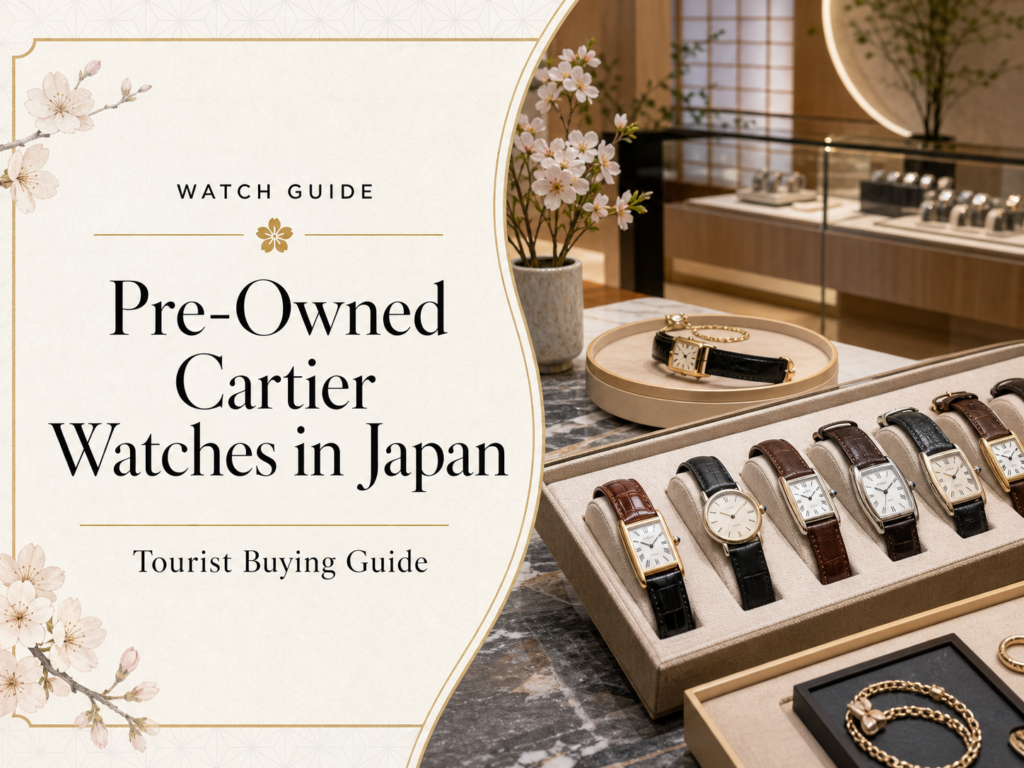
Buying a pre-owned Cartier watch in Japan can be rewarding, but the fastest useful answer is simple: choose the exact kind of watch you want, compare the same reference or function across at least two sellers, and judge the individual watch rather than the brand name alone. Japan offers several concentrated watch-shopping districts, yet no district or shop can promise a particular model, condition, price, accessory set, or purchase service on the day you visit.
For a tourist, a successful search depends on preparation. Save reference numbers or clear model descriptions, set a total spending ceiling, decide which condition compromises you will accept, and leave enough time to read written details before payment. Check official shop pages and maps before traveling because opening information, departments, appointments, and visitor services may change.
Instagram DM
Not sure which shops to visit?
Quick Answer for Tourists
Start in one district with several relevant sellers. Ginza works well for a polished central-Tokyo comparison, Nakano is useful for a specialist-heavy watch search, Shinjuku is convenient for travelers staying near a major station, and Shinsaibashi is a practical Osaka base. Use the first shop to establish a reference for case condition, bracelet or strap, included items, and displayed price. Use the second shop to test whether the first watch is still compelling.
Do not organize the day around a single online image unless the seller confirms what can be confirmed directly. Used inventory changes frequently, and listings may not answer every question about service history, parts, sizing, or purchase terms. A strong plan includes one primary shop, one contrasting seller, and one nearby backup.
JVG Editorial View
JVG views a brand-specific watch trip as a comparison exercise, not a treasure hunt with a guaranteed ending. The most useful purchase is not automatically the rarest-looking watch or the one with the fullest presentation. It is the watch whose identity, condition, function, fit, evidence, and ownership needs you understand well enough to explain after leaving the shop.
Travel pressure can distort judgment. A watch may feel urgent because it is the only example you have seen, because your flight leaves soon, or because a staff member is waiting. None of those factors improves the watch. Build a pause into the route, take notes where permitted, and compare the total proposition rather than one attractive detail.
For pre-owned Cartier, the watch itself deserves priority over accessories. Boxes and papers can be useful context and may matter to some buyers, but they do not prove current mechanical condition or erase wear. Conversely, a watch without a full set is not automatically a poor choice. The comparison should reflect your purpose, confidence, and future service plans.
Decide What Kind of Cartier Watch You Want
Define the family and use case
Relevant families may include Tank variations, Santos models, Panthere watches, Ballon Bleu designs, Must-era pieces, and other shaped cases where proportions, dial execution, movement type, and bracelet or strap strongly affect the experience. These groups should not be compared only by logo or diameter. Think about whether you need a daily watch, a dress piece, a sports watch, a chronograph, a travel watch, or a historically interesting reference.
Write down the functions you will actually use. Water-related capability, date setting, chronograph operation, magnetic resistance, bracelet adjustment, and nighttime visibility can matter differently to different travelers. Historical specifications and the present condition of a used watch are separate questions, so ask what can be supported for the individual piece.
Set reference boundaries
Before shopping, define one preferred reference range and one acceptable alternative. For each candidate record case family and dimensions, reference information, metal description, dial details, movement type, crown and cabochon condition, bracelet or strap, clasp, and included accessories. Similar-looking watches can differ in dimensions, movement, materials, dial details, bracelet construction, and service requirements.
Reference-level preparation also helps with language. A saved number and a photograph communicate more clearly than a broad request for a "vintage" or "classic" watch. Use images as a description of your target, not as evidence that a shop carries it.
Decide your condition priorities
Choose the wear you can accept before seeing a polished display. Some buyers prioritize crisp case geometry and an original-looking dial. Others prefer a serviced daily wearer with practical reliability. Some care deeply about period-correct components; others want a comfortable bracelet and readable dial. There is no universal hierarchy, but changing your priorities in every shop makes comparison unreliable.
For Cartier, pay particular attention to flat and curved case surfaces, edge definition, screws, bezel, dial printing, blued or polished hand appearance, crown, cabochon, bracelet articulation, strap wear, clasp operation, and crystal marks. Ask staff to explain written condition notes and any disclosed component changes. Do not infer originality, polishing history, water resistance, or service status from appearance alone.
Plan for ownership after the trip
Consider service access in your home country, insurance, customs declarations, travel storage, bracelet sizing, and replacement straps or links. A purchase that is easy to complete in Japan may still require planning after you return home. Confirm what documents and receipts are provided, and keep them separate from checked luggage.
Where to Look in Japan
Ginza
Ginza is efficient when you want to compare specialist watch sellers with multi-category luxury resellers in a compact central district. It can also fit a mixed shopping day involving jewelry or bags. Save exact entrances and floor details because nearby shops may occupy different buildings or upper floors.
Choose two priority stops with different roles. One can provide a specialist reference; the other can show how a broader luxury reseller presents condition and accessories. A third stop is useful only if it answers a remaining question.
Nakano
Nakano is valuable for visitors who want a watch-focused comparison and are prepared to inspect several sellers. The concentration can be efficient, but it can also create decision fatigue. Establish your checklist before entering and record each candidate consistently.
Do not assume that every seller handles the same brands, periods, services, or languages. Check current information before the trip and ask direct questions about the individual watch.
Shinjuku
Shinjuku suits travelers who prioritize transport convenience. The main planning challenge is station geography: east, west, and surrounding streets can take longer to navigate than the map suggests. Group stops by station side and avoid crossing the station repeatedly.
Shinsaibashi and Osaka
Shinsaibashi offers a practical Kansai route with specialist and multi-category resale options. Start with two nearby shops and add Namba or Umeda only if the extra area provides a different comparison. A focused Osaka half day is often more useful than a rushed citywide circuit.
How to Inspect a Pre-Owned Cartier Watch
Confirm identity before condition
Ask the seller to show how the reference, movement description, materials, and included items are recorded. Compare that information with the dial, case, bracelet or strap, and case back without trying to open or manipulate anything staff have not permitted. If an important identity point remains unclear, treat it as unresolved rather than filling the gap with an assumption.
View the case in neutral light
Look from the front, sides, back, and along the lugs. Strong display lighting can hide fine scratches or exaggerate polished surfaces. Examine edge definition, symmetry, dents, corrosion, and transitions between brushed and polished areas. Refinishing is not automatically unacceptable, but it should fit your expectations and the seller's description.
Examine the dial, hands, bezel, and crystal
Look for marks, discoloration, alignment, printing consistency, luminous-material differences, scratches, chips, and reflections that change as the watch moves. Age can produce legitimate variation, while service work can introduce newer components. Ask what the shop knows and what it does not know.
Check bracelet, strap, clasp, and fit
Bracelet links, pins or screws, end links, clasp surfaces, strap holes, deployant parts, and attachment points all affect comfort and future cost. Confirm whether spare links are included and whether sizing can be discussed. Do not assume adjustment, extra parts, or a replacement strap is included.
Ask about movement and functions
Quartz and mechanical Cartier watches require different questions. Confirm what functions can be checked, whether battery or service information is documented, and what the shop's written purchase terms cover after you leave Japan.
Test only with staff permission. Observe time setting, date change, winding feel, seconds behavior, chronograph controls, rotating bezel, or other relevant functions without forcing anything. A brief shop check is useful, but it is not the same as a long-term performance guarantee.
Separate evidence from presentation
A box, card, booklet, tag, service receipt, or seller description can add context. Confirm exactly which item belongs to the watch and what each document states. Attractive presentation should not substitute for condition, and missing presentation should be reflected in your own priorities rather than a rigid rule.
Suggested Shopping Route
Half-day Tokyo route
Choose Ginza for a compact premium comparison, Nakano for a specialist-led search, or Shinjuku for convenience. Begin at the stop most likely to establish a useful reference. At the second stop, compare the same reference or the same use case. Take a short break before deciding whether the backup shop is necessary.
Record reference, case size, movement, visible condition, bracelet or strap, included items, displayed total, and unanswered questions. When photography is restricted, write concise notes outside the shop.
Full-day Tokyo route
Use one district in the morning and one contrasting district in the afternoon. Ginza followed by Nakano can provide two different shopping environments, but allow generous transfer time and avoid adding a third major area. End with a review window rather than a transport deadline.
Osaka route
Keep the core route in Shinsaibashi. Compare a specialist seller with a multi-category reseller, then add one optional stop nearby. If you also plan to see bags or jewelry, schedule those categories after the watch comparison so your attention is fresh for the more technical inspection.
Best For Breakdown
First-time pre-owned watch buyers
- Use a clearly written checklist and compare two examples.
- Favor sellers that can explain item details and purchase terms clearly.
- Leave unresolved questions unresolved; do not convert uncertainty into confidence.
Collectors with a precise reference
- Contact shops before making a long brand-specific trip.
- Bring reference-level notes and acceptable alternatives.
- Compare components, condition, evidence, and service needs, not only year or rarity.
Travelers who want a daily wearer
- Prioritize fit, legibility, operation, service planning, and practical accessories.
- Consider how the watch will travel and how it will be maintained at home.
- Confirm current purchase terms before payment.
Visitors with limited time
- Choose one district, two priority stops, and one backup.
- Skip distant branches unless they answer a specific question.
- Keep a calm decision window at the end.
JVG Shop Selection Notes
The following shops are route references rather than rankings. Their inclusion does not indicate current Cartier inventory, a particular price, or any fixed service. Check official information and contact the exact branch when a specific reference is essential.
ALLU Ginza
- Area: Ginza
- Best for: A multi-category luxury-resale reference point
- Why it fits: This stop gives travelers a practical place to compare pre-owned Cartier watches within a focused route. Inclusion is about route usefulness, not a statement about today's stock.
- Before visiting: Check the official website and map, confirm the exact branch and relevant department, and ask directly about any item-specific service or purchase term.
KOMEHYO Ginza
- Area: Ginza
- Best for: A broad luxury-resale comparison
- Why it fits: This stop gives travelers a practical place to compare pre-owned Cartier watches within a focused route. Inclusion is about route usefulness, not a statement about today's stock.
- Before visiting: Check the official website and map, confirm the exact branch and relevant department, and ask directly about any item-specific service or purchase term.
WATCHNIAN Ginza Main Store
- Area: Ginza
- Best for: A multi-brand pre-owned watch comparison
- Why it fits: This stop gives travelers a practical place to compare pre-owned Cartier watches within a focused route. Inclusion is about route usefulness, not a statement about today's stock.
- Before visiting: Check the official website and map, confirm the exact branch and relevant department, and ask directly about any item-specific service or purchase term.
Jack Road Nakano
- Area: Nakano
- Best for: A broad watch comparison in Nakano
- Why it fits: This stop gives travelers a practical place to compare pre-owned Cartier watches within a focused route. Inclusion is about route usefulness, not a statement about today's stock.
- Before visiting: Check the official website and map, confirm the exact branch and relevant department, and ask directly about any item-specific service or purchase term.
ALLU Shinjuku
- Area: Shinjuku
- Best for: A practical luxury-resale stop near a major station
- Why it fits: This stop gives travelers a practical place to compare pre-owned Cartier watches within a focused route. Inclusion is about route usefulness, not a statement about today's stock.
- Before visiting: Check the official website and map, confirm the exact branch and relevant department, and ask directly about any item-specific service or purchase term.
KOMEHYO Shinjuku Store
- Area: Shinjuku
- Best for: A broad resale comparison in Shinjuku
- Why it fits: This stop gives travelers a practical place to compare pre-owned Cartier watches within a focused route. Inclusion is about route usefulness, not a statement about today's stock.
- Before visiting: Check the official website and map, confirm the exact branch and relevant department, and ask directly about any item-specific service or purchase term.
ALLU Shinsaibashi
- Area: Shinsaibashi
- Best for: A central Osaka luxury-resale route
- Why it fits: This stop gives travelers a practical place to compare pre-owned Cartier watches within a focused route. Inclusion is about route usefulness, not a statement about today's stock.
- Before visiting: Check the official website and map, confirm the exact branch and relevant department, and ask directly about any item-specific service or purchase term.
KOMEHYO Shinsaibashi Store
- Area: Shinsaibashi
- Best for: A second Osaka resale format
- Why it fits: This stop gives travelers a practical place to compare pre-owned Cartier watches within a focused route. Inclusion is about route usefulness, not a statement about today's stock.
- Before visiting: Check the official website and map, confirm the exact branch and relevant department, and ask directly about any item-specific service or purchase term.
How to Compare These Shops
Give every stop a job. The first should establish a benchmark, the second should challenge it, and the third should resolve a specific uncertainty. Repeat the same inspection order so lighting, display style, and sales conversation do not replace evidence.
Compare total ownership context as well as displayed price. Note condition, included links or straps, accessories, disclosed service information, adjustment needs, purchase terms, and service access after returning home. Ask about returns, warranties, repairs, shipping, payment, and tax-free procedures directly because these can vary by seller and item.
Shopping Without Speaking Japanese
Save the brand, reference, case size, dial preference, movement type, bracelet or strap preference, and budget on your phone. Useful questions include "May I check the condition?", "What is included?", "Has any service information been documented?", "Are extra links included?", and "Could you explain the purchase terms?"
Translation tools can support a conversation, but important terms should be confirmed in writing where possible. English support varies by shop, person, and time. Keep receipts, descriptions, and service documents organized after purchase.
What to Check Before Visiting
- Check the official website, exact branch, map, and opening information shortly before travel.
- Confirm whether the branch is relevant to pre-owned watches without assuming a specific brand or reference is present.
- Ask directly about appointments, payment, tax-free procedures, returns, warranty, repair, sizing, shipping, and aftercare.
- Bring your passport if you plan to ask about tax-free shopping, while recognizing that eligibility and procedures must be confirmed.
- Save your preferred reference, dimensions, and alternatives.
- Leave time to inspect the watch and review written details without a train or flight deadline.
- Plan secure travel storage and understand customs obligations for your destination.
Related JVG Guides
- Read the vintage watches in Japan complete buying guide.
- Read the how to buy pre-owned watches in Japan.
- Read the pre-owned and vintage watch shops in Tokyo.
- Read the Ginza pre-owned watch guide.
- Read the Nakano watch-shop guide.
- Read the Osaka pre-owned watch guide.
- Read the tax-free shopping for second-hand goods.
FAQ
Is Japan a good place to compare pre-owned Cartier watches?
Japan can be practical because several visitor areas contain multiple watch sellers, allowing side-by-side comparison. That does not guarantee a particular reference, condition, price, or accessory set. The value comes from planning a concentrated route and inspecting each watch carefully.
Can I confirm authenticity from the box and papers?
No single accessory should replace an item-level evaluation. Review the seller's written description, the watch, reference information, disclosed service history, and included documents together. Ask what the shop supports in writing and seek independent specialist advice when the risk exceeds your comfort.
Should I choose a full set or the watch in better condition?
That depends on your purpose. A collector may value period context, while a daily wearer may prioritize fit, condition, and service planning. Compare the complete proposition and do not let packaging hide questions about the watch itself.
Are tax-free shopping, returns, and warranties the same at every shop?
No. Procedures, eligibility, exclusions, and aftercare can vary by shop, item, and timing. Confirm each point directly before payment and consider how any support would work after you leave Japan.
How many watch shops should I visit in one day?
Two to four focused stops are enough for many travelers. More shops can help only when you can still inspect consistently and remember the differences. A short, deliberate route usually produces better decisions than an exhausting list.
Shopping Support CTA
Need help planning your vintage shopping route in Japan? Contact JVG for private shopping support.
Shopping Support: Plan your route with JVG
Continue the shopping journey