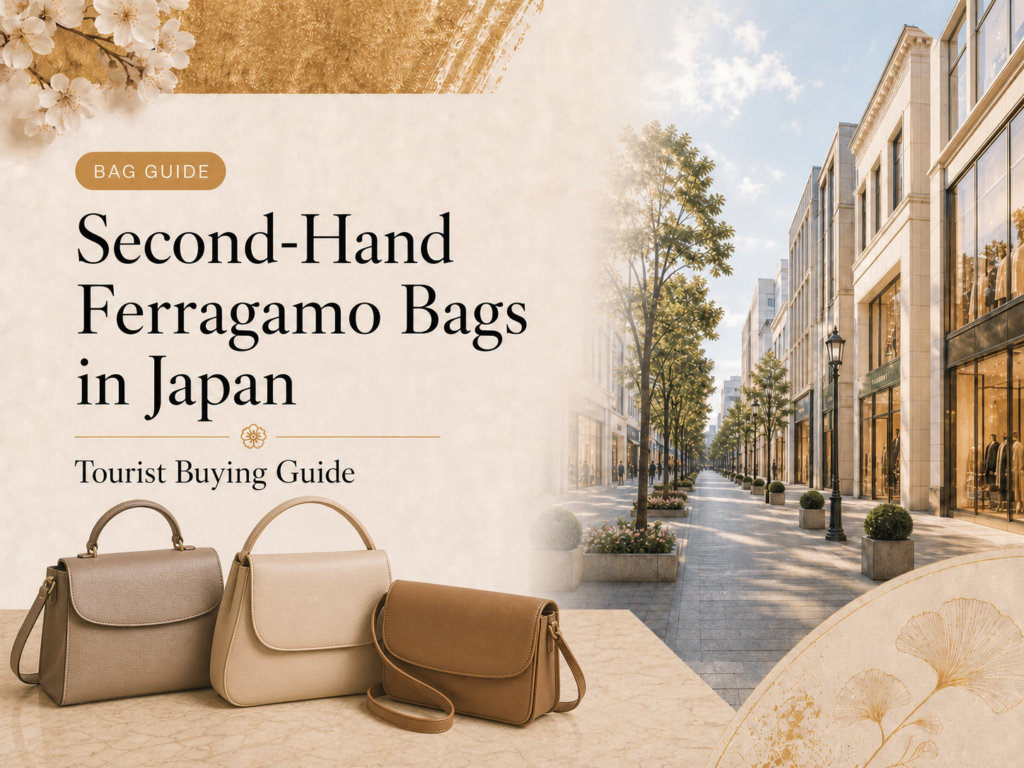
Searching for a second-hand Ferragamo bag in Japan is most productive when you begin with the way you plan to use the bag. A structured handbag for formal travel, a softer shoulder bag for everyday use, and a compact evening design require different checks. Japan offers several luxury-resale districts where international visitors can compare these formats, but current brand inventory can never be assumed.
This guide helps travelers choose an area, understand store types, inspect an individual bag, and build a calm comparison route. It does not confirm live stock, prices, opening hours, tax-free service, returns, warranties, repairs, or included accessories. Check official shop information before visiting and confirm item-specific details before buying.
Instagram DM
Not sure which shops to visit?
Quick Answer for Tourists
Choose one main luxury-resale district and compare no more than three serious options in a half day. Ginza is useful for a polished multi-store comparison, while Shinjuku offers convenience around a major transport area. Omotesando and Shibuya provide a more fashion-oriented route. In Osaka, Shinsaibashi is the clearest starting point.
At the first shop, establish the bag size, structure, material, and condition level that feel right. At the second, compare a different shape or store format. Use the third as a backup or a final check. If you want one exact Ferragamo model, color, hardware detail, or period, check current listings or contact the shop rather than building a journey around an unconfirmed item.
JVG Editorial View
Ferragamo bag searches often appeal to travelers who value a refined shape, considered hardware, or a quieter design rather than the most visible logo. That makes proportion and construction especially important. A bag can look elegant on a shelf yet feel too formal, too heavy, or too small for the buyer's real routine.
JVG recommends comparing the individual product before comparing the prestige of the district or the presentation of the store. Look at the way the bag opens, how its base sits, where the strap falls, and whether the hardware works comfortably. Think about the clothes and situations in which you would use it. A travel purchase is stronger when it fits life after the trip.
Older and newer-looking designs may appear side by side in resale. Do not guess the age, material, or model from appearance alone. Use the shop's written description and ask for clarification. Current stock is unpredictable, so the purpose of a route is to improve comparison, not to promise a specific discovery.
Choose the Right Ferragamo Bag Format
Structured top-handle bags
A structured top-handle bag should be viewed from every side. Check whether the base sits evenly, whether the sides retain their intended shape, and whether the handle attachment points show stress. Examine the opening and confirm that it is practical for the items you carry.
If a shoulder strap is relevant, confirm that it is included and check how it attaches. A detachable strap can change the usefulness of a formal-looking bag, but accessory sets vary by individual item.
Shoulder bags
For a shoulder bag, pay attention to strap drop, weight, closure, and how the bag rests against the body. Try it over the type of clothing you expect to wear, within shop rules. A strap that works over a light shirt may feel different over a coat.
Look at the underside of the strap, edge finishing, hardware connections, and areas where the bag rubs against clothing. Decide whether the opening is secure enough for trains, streets, and sightseeing.
Crossbody and compact day bags
Compact bags should be measured against your actual essentials. Phone dimensions, wallet size, glasses, hotel key, and travel documents can quickly fill a narrow interior. Check whether the opening allows easy access and whether the strap adjusts to a comfortable length.
Do not let the word compact substitute for usability. A slightly wider or softer bag may be more practical than a rigid mini format with an attractive exterior.
Evening and occasion-focused bags
An occasion bag may prioritize shape and presentation, but the closure, chain or strap, lining, and capacity still matter. Consider how the bag will be stored and transported during the rest of your trip. Delicate surfaces and prominent hardware may require more care than an everyday design.
Ask exactly what is included, especially when a detachable chain, strap, pouch, or protective item affects use.
Where to Look in Japan
Ginza for a polished comparison
Ginza offers several established luxury-resale formats within a central shopping district. It is suitable for travelers who want to compare Ferragamo with other understated or structured designer bags, or who are combining bags with watches and jewelry.
Plan the exact order before arriving. Stores may occupy different floors or sections of the district, and a compact route can still take longer than expected. Begin with a broad reseller, then add one contrasting shop. Leave room to return to the strongest candidate.
Omotesando and Shibuya for fashion context
Omotesando can add a curated perspective, while Shibuya connects luxury resale with a wider fashion-shopping day. These areas are helpful when styling and daily use matter as much as the label. They should not be treated as one effortless cluster; choose a primary district and add the other only when it serves a clear purpose.
Check hills, station exits, and shop locations on the map. Crowds can make an ambitious route tiring, especially when you need time for close inspection.
Shinjuku for convenience
Shinjuku works well for travelers staying nearby or connecting through the station. Its challenge is navigation. Group stores by one side of the station and save the correct exits. The first stop should provide a clear baseline for shape, condition, and price context.
Do not cross the entire station area for a branch unless it offers a different store format or a relevant current listing. A focused route is more useful than a long list.
Shinsaibashi for an Osaka route
Shinsaibashi is a practical base for comparing luxury-resale shops in Osaka. It can support a half-day route on its own or form the main section of a longer Minami shopping day. Add Namba only when it expands the comparison rather than repeating it.
Confirm exact addresses and branch names before visiting. Osaka store names may use city and neighborhood labels differently, and a saved map pin reduces unnecessary walking.
What to Inspect Before Buying
Shape, panels, and base
Place the bag on a flat surface when permitted and view its balance. Check front and back panels, side folds, the base, and any feet. Structured designs may show leaning, pressure, or uneven shape that is less visible when the bag is held.
Soft construction should also be evaluated. Decide whether the natural drape works with the contents you plan to carry, and whether creasing or storage marks are acceptable to you.
Leather and other materials
Use the shop's description to identify materials. Different leathers, coated surfaces, fabric, lining materials, and trims age differently. Inspect high-contact areas without assuming that one clean panel describes the entire bag.
Look at corners, edges, handle bases, strap surfaces, and the back panel. Color transfer, dryness, marks, or texture changes may be easier to see from an angle or under different light.
Hardware and closures
Hardware can be central to the design, so inspect scratches, finish changes, alignment, and operation. Open and close the bag only as permitted and do not force any mechanism. Ask staff if a closure feels unclear.
Consider usability as well as appearance. A decorative closure may be less convenient for frequent access. Decide whether that tradeoff suits your routine.
Handles and straps
Check the handle surface, edge finish, attachment points, strap holes, buckles, clips, and adjustment range. Wear can be concentrated where the strap bends or connects to hardware. Confirm that detachable components are included.
Try the bag at the length you expect to use. Body height, clothing, and intended carry style can make the same strap feel very different between shoppers.
Interior and included items
Inspect the lining, pocket edges, seams, base, and areas around closures. Ask about marks, residue, or odor that you cannot understand. A neat exterior should not end the inspection.
Confirm boxes, dust bags, straps, pouches, cards, tags, and other included items individually. Their presence should be recorded, not assumed.
Price, Condition, and Value
Used bags should be compared as individual combinations of design, condition, practicality, included items, and price. Two Ferragamo bags with similar silhouettes can differ in material, dimensions, hardware, wear, or accessory set. A lower price does not automatically make one the better fit.
Exchange rates, foreign card fees, and the way you plan to transport the bag can affect the overall purchase. Decide on a budget range before the route, but keep a separate list of non-negotiable product requirements. This prevents price alone from overriding comfort or condition.
Do not rely on a general condition grade without reading item details. Shops may use different systems. Compare the visible product and written description in the same order at every stop.
Suggested Shopping Route
Half-day Ginza route
Start at one multi-category reseller and use it to compare structured, shoulder, and compact formats. Continue to a second Ginza store with a different presentation or category mix. Take a break before visiting the backup.
Keep a note for each serious candidate: dimensions, weight impression, strap, closure, visible wear, material description, included items, and total price. If one option remains strong after the break, return for a final inspection.
Half-day Omotesando and Shibuya route
Begin in the area that matters most to the rest of your day. Use a curated store for design context, then compare a broader reseller or fashion-led store. Avoid adding Harajuku, Omotesando, and all of Shibuya automatically. Select two clusters that can be covered without rushing.
This route suits travelers who want the bag to work with a wider wardrobe rather than treating it as an isolated luxury purchase.
One-day Tokyo route
Use the morning for a polished comparison in Ginza or Shinjuku. After lunch, move to Shibuya or Omotesando only if you still need a different style perspective. Build a decision break into the schedule and avoid placing a high-value purchase immediately before a train or reservation.
Osaka route
Use Shinsaibashi as the anchor. Compare two nearby luxury-resale formats, then review your shortlist before adding another area. Keep sightseeing and dining plans flexible enough that the bag inspection is not rushed.
Best For Breakdown
Travelers seeking an understated designer bag
- Focus on proportion, material, and daily usefulness.
- Compare presentation details without assuming a specific design is available.
- Choose wear that feels appropriate for your intended use.
Structured-bag shoppers
- Inspect shape, base stability, panels, handles, and closures.
- Confirm detachable straps and accessories individually.
- View the bag from every side rather than only from the front.
Occasion and evening-bag shoppers
- Test capacity against the exact items you need.
- Check chains, straps, closures, and delicate surfaces.
- Plan how the bag will be protected during the rest of the trip.
Buyers with limited time
- Choose one district and two primary stores.
- Use current listings only as leads, not availability promises.
- Add a backup nearby instead of crossing the city.
JVG Shop Selection Notes
These stores offer different luxury-resale settings in major shopping areas. They are practical stops for comparison, not a ranking, and their inclusion does not confirm current Ferragamo stock.
ALLU Ginza
- Area: Ginza
- Best for: A refined luxury-resale reference point
- Why it fits this guide: It provides a polished setting for comparing structured and contemporary designer bags.
- Before visiting: Check official shop details and current categories.
BRAND OFF Ginza Main Store
- Area: Ginza
- Best for: A broad luxury-bag comparison
- Why it fits this guide: It can help travelers establish a multi-category reference early in a Ginza route.
- Before visiting: Confirm the exact location and do not assume brand inventory.
KOMEHYO Ginza
- Area: Ginza
- Best for: Comparing bags with related luxury categories
- Why it fits this guide: It adds another established resale format within the same central district.
- Before visiting: Check official information and current store details.
AMORE Vintage Omotesando
- Area: Omotesando
- Best for: A curated vintage-luxury perspective
- Why it fits this guide: It offers a contrasting environment for shoppers interested in distinctive design and styling.
- Before visiting: Confirm the address, current categories, and map before visiting.
BRAND OFF Shibuya Store
- Area: Shibuya
- Best for: Combining luxury resale with a fashion day
- Why it fits this guide: It gives travelers a central Shibuya comparison outside the Ginza route.
- Before visiting: Check the official website and current shop information.
ALLU Shinjuku
- Area: Shinjuku
- Best for: A convenient Tokyo luxury-resale route
- Why it fits this guide: It suits visitors who want to keep comparison close to a major transport area.
- Before visiting: Save the map and correct station exit.
ALLU Shinsaibashi
- Area: Shinsaibashi
- Best for: An Osaka luxury comparison
- Why it fits this guide: It gives Kansai travelers a central option without requiring a Tokyo itinerary.
- Before visiting: Confirm current details through official channels.
BRAND OFF Shinsaibashi Store
- Area: Shinsaibashi
- Best for: A second Osaka resale format
- Why it fits this guide: It can be paired with another Shinsaibashi stop for a compact comparison.
- Before visiting: Check the exact entrance and map before visiting.
How to Compare These Shops
Begin broad, then become specific
The first store should help define acceptable size, structure, condition, and price context. The second should answer a specific question about styling, age, material, or convenience. The third should be a backup, not another unplanned repetition.
Use consistent notes
Record dimensions, shape, material description, closure, handles, straps, hardware, interior, condition notes, included items, and price. A repeated checklist makes comparison more reliable than memory.
Revisit the purpose of the bag
Before payment, ask where and how you will use the bag. Consider work, travel, evenings, climate, clothing, and what must fit inside. A well-presented resale item should still solve a real need.
Shopping Without Speaking Japanese
Prepare a phone note with the brand name, desired format, approximate size, preferred material or color, and budget range. Use short questions and show the item tag when asking about condition or included accessories.
Useful questions include:
- "Can I check the condition?"
- "What are the dimensions?"
- "Is this strap included?"
- "How does this closure work?"
- "Could you explain this note?"
- "What are the current purchase terms?"
Language support varies. Use translation tools when helpful, but confirm important facts directly with staff and written item information.
What to Check Before Visiting
- Check the official website and map before visiting.
- Confirm that the branch currently handles designer bags.
- Treat online listings as time-sensitive leads.
- Save one nearby alternative shop.
- Bring the dimensions of a bag you already use.
- Prepare your passport if you plan to ask about tax-free shopping, but confirm current eligibility and procedures.
- Ask about payment, returns, warranties, repairs, shipping, and included items before payment.
Related JVG Guides
- Use the vintage bags in Japan complete shopping guide to compare major cities and bag routes.
- Read the used designer bags in Japan guide for a broader product checklist.
- Compare another brand-focused route with the second-hand Prada bags in Japan guide.
- Review how to buy second-hand luxury goods in Japan before purchasing.
- Use the Ginza vintage shopping guide when Ginza is your main district.
- Read the shopping tips for international visitors for practical preparation.
Planning Support
If you are looking for a specific bag style, a planned route can help you compare store formats without spending the day moving between distant districts. JVG can help organize realistic areas and shopping priorities for your Japan itinerary.
Need help planning your vintage shopping route in Japan? Contact JVG for private shopping support.
Shopping Support: /shopping-support/
FAQ
Can I expect a specific Ferragamo bag to be available?
No. Inventory changes frequently. Check current official listings or contact shops when a particular model, color, size, material, or hardware detail is essential.
Is Ginza the only area worth checking?
No. Ginza is convenient for a polished comparison, but Shinjuku, Shibuya, Omotesando, and Shinsaibashi can suit different itineraries and store preferences.
What should I inspect on a structured bag?
Check the base, side panels, shape, handles, attachment points, hardware, closure, interior, and included straps or accessories. View the bag from every side.
How should I compare price?
Compare price with condition, dimensions, material, usability, included items, and shop terms. Similar-looking bags may not be equivalent.
Is tax-free shopping guaranteed?
No. Availability and eligibility vary. Bring your passport if you plan to ask and confirm the current procedure directly with the shop before payment.
Continue the shopping journey